
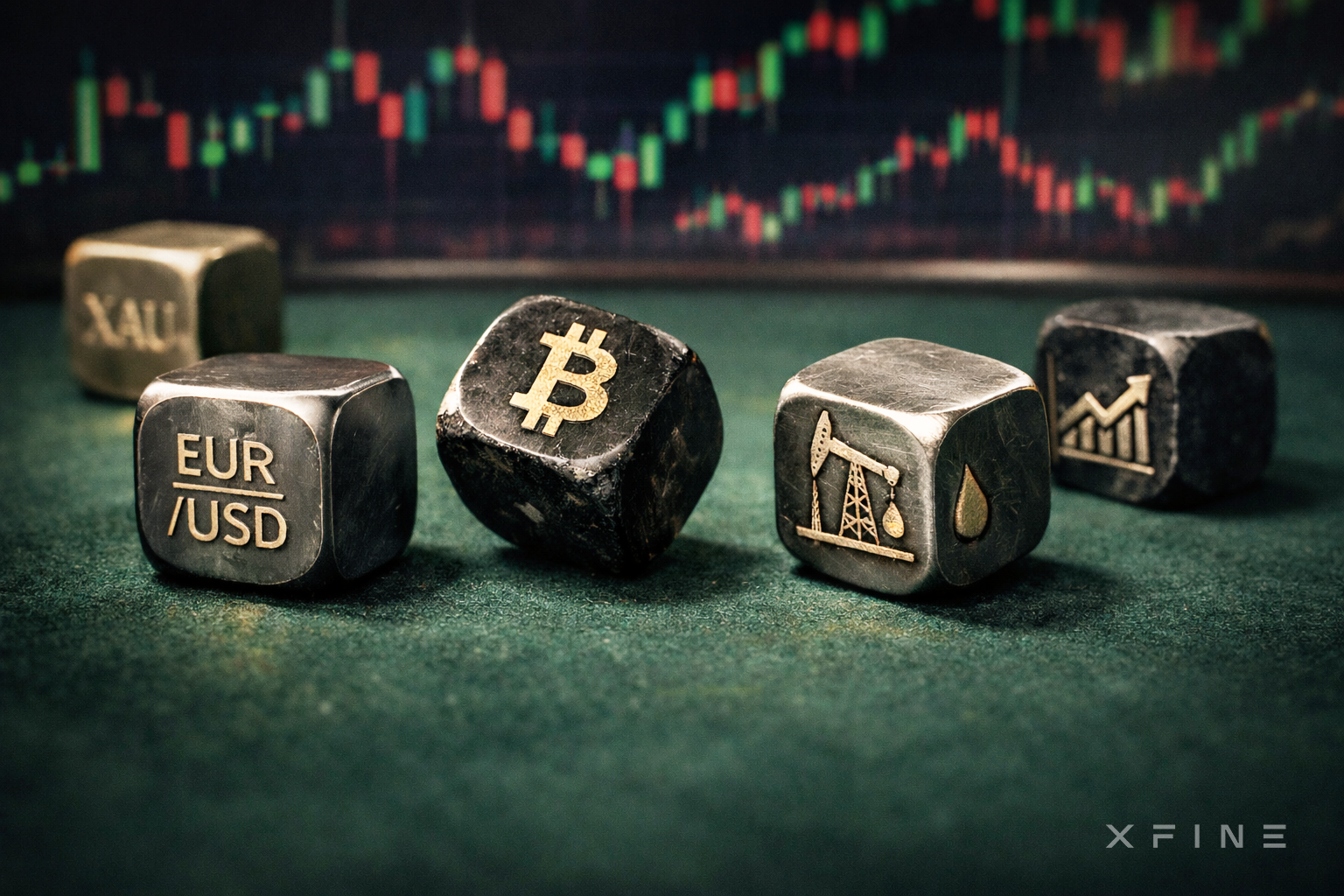
The beginning of 2026 has become a moment of final reassessment of familiar approaches to online trading for participants in financial markets. Universal solutions that only a few years ago allowed traders to work relatively steadily across several asset classes at once have gradually lost their effectiveness. According to XFINE’s assessments, the key success factor under the new conditions is no longer the choice of an abstract strategy, but the precise alignment of a trading instrument with the current market environment. Uncertainty in the monetary policy of the world’s leading central banks, persistent geopolitical tensions, and structural shifts in the global economy have led to volatility ceasing to be a temporary phenomenon and increasingly being perceived by the market as a new norm.
In 2026, the foreign exchange market formally retains its status as the most liquid segment, yet the nature of price movements has changed noticeably. According to analysts at JPMorgan and Deutsche Bank, as stated in their public comments, forex is becoming less suitable for building long-term positional ideas. Stable trends have been replaced by compressed ranges, sharp impulses, and heightened sensitivity to macroeconomic data and regulatory rhetoric. Traders’ primary focus remains on pairs involving the US dollar, but activity in cross rates, including currencies of emerging economies, is becoming increasingly pronounced. Analysts at ING have noted that elevated volatility in this segment may persist for another 12-18 months, making such instruments attractive for short-term trading but potentially risky for conservative approaches. Under these conditions, as noted by XFINE, the role of precise timing and advanced risk management tools is growing.
Over the past year, the cryptocurrency market has firmly established itself as an independent asset class. bitcoin and ethereum continue to set the overall direction, yet the structure of price movements has become noticeably more institutional. Representatives of BlackRock and Fidelity Digital Assets have repeatedly emphasised that the inflow of large-scale capital reduces market chaos but does not eliminate volatility, instead making it more predictable in form. According to Bloomberg Intelligence, in 2026 the trading ranges of key digital assets are still expected to exceed those of the forex market by 2-3 times. For traders, this means the preservation of high return potential, provided strict discipline and control over position sizes are maintained. In the middle of last year, experts also pointed out that cryptocurrencies are increasingly viewed by experienced market participants as a diversification tool rather than as an isolated speculative environment.
Precious metals have once again come into focus recently, but their role has evolved significantly. Analysts at UBS and the World Gold Council have indicated that gold continues to perform a protective function amid geopolitical risks and threats of a slowdown in the global economy, while the growth of intraday volatility has turned it into a fully fledged instrument for active trading. According to XFINE data, gold ranks among the TOP-3 most traded instruments among retail clients, confirming its versatility in an unstable market environment. Silver develops this dynamic further due to the dual nature of demand, combining investment appeal with a high dependence on industrial consumption. Experts at Société Générale have noted that in 2026 instability in global supply chains may amplify precisely the price volatility of silver, making it one of the most sensitive metals to changes in economic conditions.
Energy commodities continue to remain one of the most challenging segments to forecast. Oil and gas respond not only to supply and demand balances, but also to political decisions, sanctions regimes, and regional conflicts. Representatives of OPEC and the International Energy Agency have repeatedly emphasised the fragility of the current market balance. Analysts at Goldman Sachs note that in 2026 energy commodities are becoming instruments primarily for experienced traders who are prepared to work with high volatility and take the news backdrop into account. Experts also observe that, despite sustained interest in oil-related instruments, an increasing number of traders prefer to limit themselves to short-term trades, avoiding the holding of positions through periods of heightened uncertainty.
As a result, in 2026 the market is increasingly dictating the rules for instrument selection. Forex remains a space of high liquidity and precision trading, cryptocurrencies offer structured but elevated volatility, precious metals combine protective properties with opportunities for active trading, while energy commodities require maximum experience and caution.
Under these conditions, access to a broad range of markets becomes particularly important. The brokerage company XFINE provides the opportunity to trade more than 3000 different assets, including not only the main classes of instruments but also shares of international companies operating in the relevant sectors of the economy. This allows traders to switch quickly between instruments depending on current market conditions and to use different sources of market dynamics. XFINE emphasises that the quality of trading infrastructure, technological resilience, and flexible execution conditions are also of decisive importance, enabling work across different asset classes without increasing systemic risks.


